
Problem statement (Leetcode Hard)
- You are given the head of a singly linked list head and a positive integer k.
- You must reverse the first k nodes in the linked list, and then reverse the next k nodes, and so on. If there are fewer than k nodes left, leave the nodes as they are.
- Return the modified list after reversing the nodes in each group of k.
- You are only allowed to modify the nodes' next pointers, not the values of the nodes.
Solution (recursion)
(I had such a hard time trying to do this iteratively... the recursion version makes muuuch more sense.)
public class Solution {
    public ListNode reverseKGroup(ListNode head, int k) {
        ListNode cur = head;
        int group = 0;
        while (cur != null && group < k) {
            cur = cur.next;
            group++;
        }

        if (group == k) {
            cur = reverseKGroup(cur, k);
            while (group-- > 0) {
                ListNode tmp = head.next;
                head.next = cur;
                cur = head;
                head = tmp;
            }
            head = cur;
        }
        return head;
    }
}
Strategy
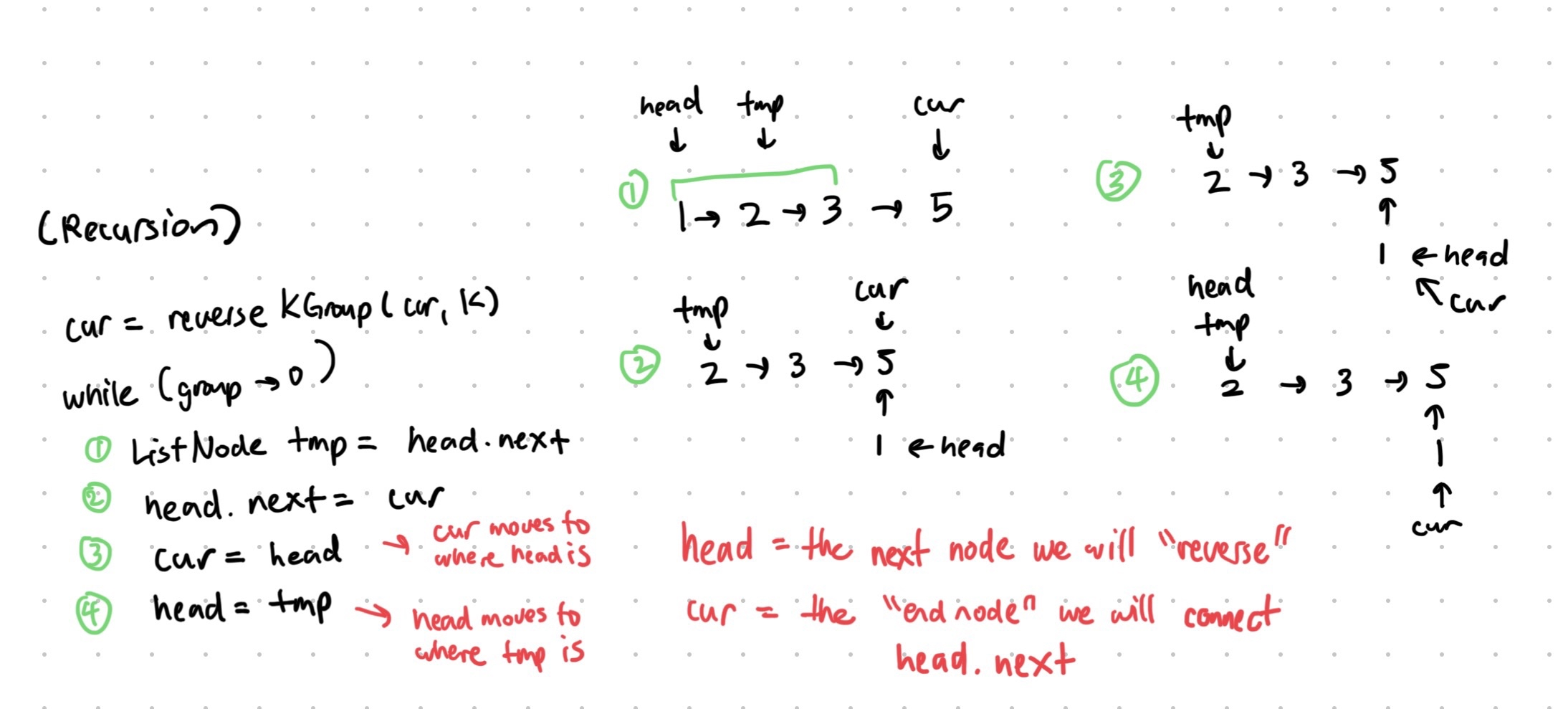
- The
curvalue returned fromreverseKGroup(cur,k)will be already reversed and be ready for you. - In the reversing while loop
head-> the next node we want to reversecur-> the "end node" that we will connecthead.next
- The
head = curafter the while loop- in the end,
ListNode tmp = head.nextwill be the last element (the very first initialcurthat we got from recursion) - and
curwill be at the beginning - so we set
head = curto return the head for next iteration (from the recursion).. or we can also just simple returncur
- in the end,
Time complexity
O(N)- in the first visit, we check each node(
ksteps) to check if there are enough nodes. - Then inside the
if (group == k)block, theheadpointer iterates through those sameknodes. - So roughly the total operations are
O(2N), but it's reduced toO(N).
- in the first visit, we check each node(